
5 Faults We Found Behind One Old Consumer Unit (Case Study)
What We Found Behind One Customer's Old Fuse Board
We replaced a consumer unit for a customer near Horley last Thursday. What should have been a straightforward swap turned into a full rewrite of the job once we opened up the old board. It was riddled with DIY work that should never have been signed off.
Here's what we found, and why each one mattered.
1. An unprotected sub-board
The property had a second consumer unit fed straight off the bottom of the main switch, with no overcurrent protection on the way to it. That sub-board was supplying a 10mm SWA cable. The cable itself had a joint spliced in partway along its run, sitting inside a plastic box that wasn't rated for the job and held to the wall with a single screw.
Without a breaker or fuse sized to protect that cable, a fault anywhere on the sub-board's circuits wouldn't necessarily trip anything upstream. The cable could overheat and the joint could fail before the fault ever cleared.
2. Two ring finals crammed onto one 40A MCB
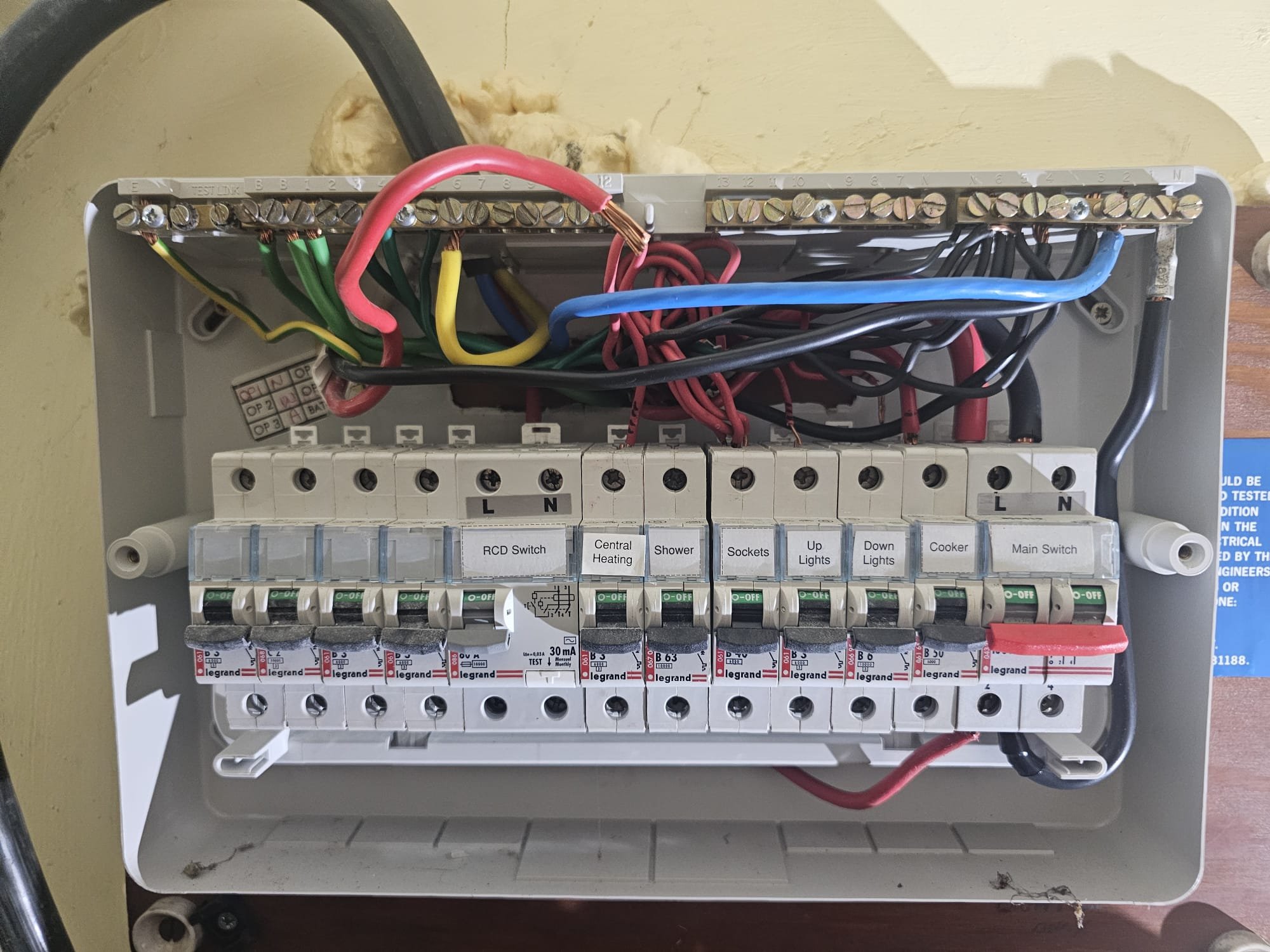
Both ring final circuits - the sockets serving most of the house were connected to a single 40A MCB with no RCD protection at all. Two rings on one breaker means neither circuit is individually protected the way it should be. And without an RCD, a fault to earth (a damaged cable, a faulty appliance, someone touching a live part) has nothing to cut the power quickly. That's the protection that actually saves lives.
3. A cooker circuit on the wrong-sized breaker
The cooker was wired in 6mm cable but protected by a 50A MCB. 6mm T&E is only rated for that kind of load in specific installation conditions, and here it wasn't one of them. The breaker would let far more current flow through that cable than it's designed to carry before it ever tripped.
4. A shower circuit on the wrong-sized breaker
Same problem on the shower: 10mm cable protected by a 63A MCB. Oversizing the breaker on a shower circuit is a common DIY mistake, because a shower draws a lot of current and people assume a bigger number means "safer." It's actually the opposite. The breaker has to match the cable, not the appliance, or the cable is the thing that fails first.
5. Bare copper everywhere in the board
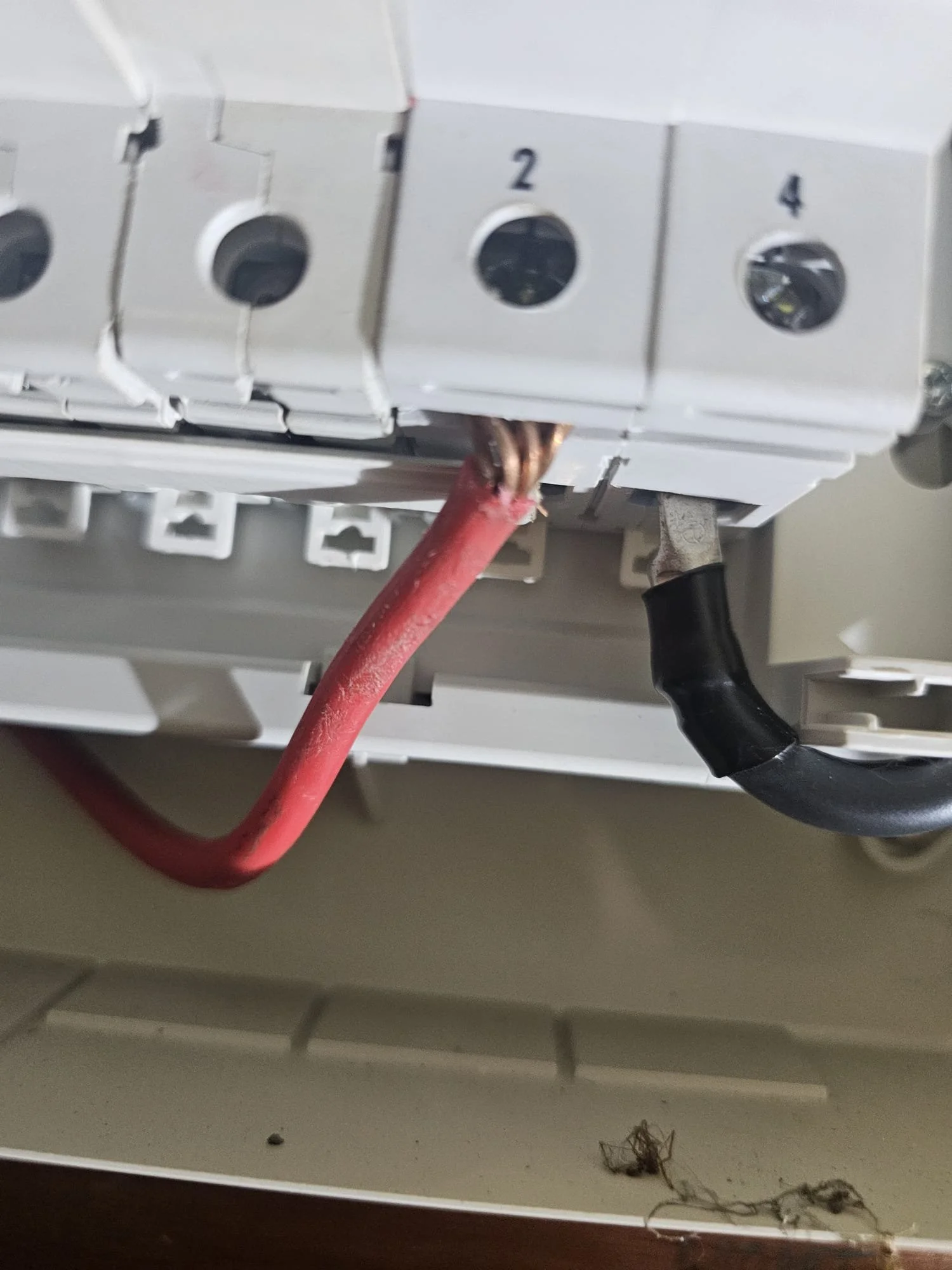
Throughout the board, conductors were left with far more exposed copper at the MCB terminals than they should have been. Wire was stripped back too far, with bare copper sitting outside the terminal rather than clamped inside it. That's live copper sitting inches from other live parts - an easy way to end up with an arc or a short.
What We Did
We stripped the board back and rewired it properly: correctly rated overcurrent protection on the sub-board feed, the two ring finals split onto their own RCD-protected ways, the cooker and shower circuits matched to breakers sized for their actual cable ratings, and every termination redone with the right amount of conductor exposed and properly torqued down.
The unit passed testing afterwards with no faults recorded. Before we touched it, most of what we found had no way of failing safely.
If your consumer unit hasn't been looked at by a qualified electrician in a while - especially if any of the wiring predates you living there, it's worth having it checked. Faults like these don't show up until something goes wrong.
Frequently Asked Questions
Why does a breaker need to match the cable, not the appliance? A circuit breaker's job is to protect the cable from overheating, not to match the appliance's power draw. If the breaker is rated higher than the cable can safely carry, the cable can overheat and fail well before the breaker ever trips - which defeats the point of having protection at all.
Is it dangerous to have two ring final circuits on one MCB? It's not compliant with current wiring regulations and removes the individual protection each ring is meant to have. Combined with no RCD protection, a fault on either ring has no fast way of being cut off, which is a genuine safety risk rather than just a technical box left unticked.
Can DIY electrical work really go unnoticed until an inspection? Yes. Many of the faults found in cases like this - wrong-sized breakers, missing RCD protection, poor terminations - don't cause an obvious, immediate problem. The circuit still works day to day. That's exactly why they can sit undetected for years until a proper inspection or a fault actually occurs.
How do I know if my consumer unit has issues like these? Visually, most of these faults aren't detectable without opening the board and testing the circuits — which is why a professional inspection matters even if everything seems to be working normally. If your property's wiring history is unknown, or any part of it predates when you moved in, it's worth having it properly assessed.
