
By Mark Summerton, NAPIT-registered electrician · Updated 30 October 2026
Quick answer: you need a full rewire if your house still has old rubber, lead or fabric-covered cable, or if testing shows faults across lots of circuits. A partial rewire is enough when the existing wiring is modern PVC cable that tests well, and you only need to change one area, like a kitchen, extension or loft. Testing tells you which, not the age of the house.
People usually call me about rewiring for one of two reasons. Either they're buying an older house and the survey has flagged the electrics, or they're about to do building work and want to know if the wiring should be done first. Both come down to the same question: does the whole house need doing, or just part of it?
What's the Difference?
A full rewire replaces every circuit in the house. That's all the cable, every socket, switch and light point, the earthing and bonding, and usually a new consumer unit. You end up with a brand new installation and an Electrical Installation Certificate (EIC) to prove it.
A partial rewire replaces only some circuits. That might be one room, one floor, or just the circuits being changed during a renovation. The new work connects to the existing installation, so the rest of the wiring has to be in good enough condition to connect to.
Full vs Partial Rewire at a Glance
| Full rewire | Partial rewire | |
|---|---|---|
| What's replaced | Every circuit, plus consumer unit, earthing and bonding | Selected circuits or rooms only |
| Typical cost | From £4,500 + VAT | Quoted after a survey, depends on the area |
| Typical time | 1 to 2 weeks for a 3-bed house | 1 to 3 days for one room or floor |
| Disruption | Floorboards up and walls chased throughout | Limited to the area being rewired |
| Certificate | Full EIC for the whole house | EIC or Minor Works certificate for the new work |
| Best for | Old cable, failed EICRs, major renovations | Extensions, kitchens, lofts, sound PVC wiring |
Signs Your House Needs a Full Rewire
Age on its own isn't the test. I've seen 1970s wiring in great condition and 1990s wiring that was a mess. These are the signs that mean a full rewire is almost always the right answer:
Rubber, lead-sheathed or fabric-covered cable. These were used up to the 1960s. The insulation goes brittle and cracks, and it can't be repaired.
Green goo at sockets or switches. This comes from old PVC cable breaking down and is a sign the insulation is failing. What "cable cancer" is.
Round-pin sockets or a fuse box with rewireable fuses. Usually a sign the wiring behind them is just as old.
No earth on the lighting circuits. Common in older houses, and a problem if you ever want metal light fittings.
An EICR with C2 codes on several circuits. When faults are spread across the house, fixing them one at a time costs more than starting again.
When a Partial Rewire Is Enough
A partial rewire makes sense when the rest of the house is sound and you're only changing one part of it. Common examples:
A kitchen refit. New circuits for the oven, hob and appliances, and new socket positions.
An extension or loft conversion. New circuits for the new space.
One damaged circuit. For example, after a leak, or where a previous owner's DIY has gone wrong.
The key word is sound. Before I quote a partial rewire, I test the existing installation it will connect to. If the earthing isn't up to standard or the consumer unit has no RCD protection, those have to be put right too. The new work can't be signed off otherwise.
The Partial Rewire Trap
The most expensive rewire I see is the one done twice. A homeowner rewires the kitchen, then the bathroom a year later, then the upstairs. By the end they've paid for three lots of disruption, three call-outs and three lots of making good. That often comes to more than one full rewire would have cost.
If you're planning several projects over the next few years, ask for both prices. And if you're about to replaster, lay new floors or redecorate, rewire first. Chasing cables into new plaster means doing the plastering twice.
How I Work Out Which One You Need
I don't guess from the outside. I start with a rewiring survey, or an EICR if you need the paperwork anyway. I test the circuits, look at the cable at the consumer unit and a few accessories, and check the earthing. You then get a written quote for the option that makes sense, and I'll tell you if the other one is worth considering.
Period properties in Reigate and Redhill often need a different approach. They have solid walls, original features and floors that people want to keep. I've written about that on the Reigate electrician page.
A Recent Full Rewire in Horley
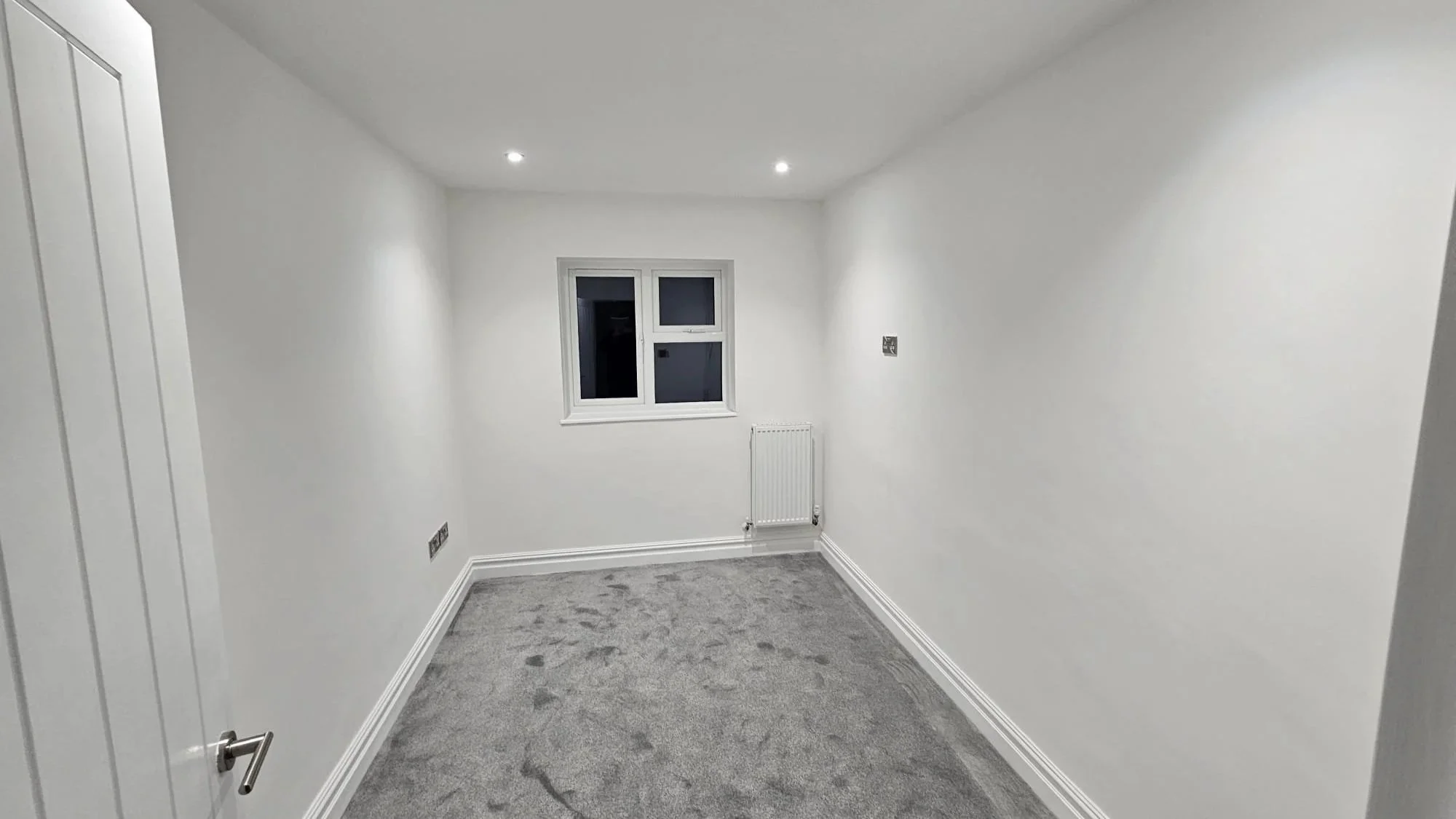
This is a house I’ve just finished in Horley. Every circuit was replaced, with LED downlights throughout, new sockets where the owners actually needed them, and a bathroom done properly: bathroom-rated downlights, an extractor fan and an illuminated mirror wired in. The rewire was done before plastering and decorating, so everything is flush and nothing had to be patched afterwards. That’s the best time to do it.
What a Rewire Costs
A full rewire starts from £4,500 + VAT. What moves the price:
Size of the house and the number of circuits
Access, like solid floors, solid walls or a boarded-out loft
What you want added, like extra sockets, outside lights, a shed supply or EV charger prep
Making good. Plastering and decorating are usually separate, and my written quote says exactly what's included.
Partial rewires are priced on the area. See the price guide for my other starting prices, or the house rewiring page for how the job runs day to day.
Get a Rewire Quote in Surrey
I rewire homes across Horley, Reigate, Redhill, Crawley and the villages around them. Every rewire comes with a full certificate, Building Regulations notification through NAPIT, and a 24-month guarantee on my work.
Call 07508 224603 or request a quote.
Rewiring: Frequently Asked Questions
How long does a full rewire take?
About 1 to 2 weeks for a typical 3-bed house. Bigger homes, solid walls and difficult access take longer.
Can I live in the house during a rewire?
Many people do. It's easier if rooms can be cleared one at a time. I'll go through how it would work in your house at the survey.
Does a rewire need Building Regulations approval?
Yes, a rewire is notifiable work. As a NAPIT-registered electrician, I notify it for you and you receive a Building Regulations compliance certificate. There's no separate council fee.
Do I need a new consumer unit with a partial rewire?
Not always. But new circuits need RCD protection, so an old fuse box usually has to be replaced at the same time. A consumer unit upgrade starts from £600 + VAT.
Can I do a partial rewire now and the rest later?
Yes, if the existing wiring tests well. Just bear in mind that doing it in stages usually costs more in total than one full rewire.
